
mmWave RF Transceiver and Digital Beamforming Products
BeammWave’s unique, patented system solution combines low power consumption and low complexity with uncompromised digital beamforming performance. It simplifies integration through flexible antenna placement, without the thermal constraints of tightly integrated antenna modules or the need to route high-frequency RF signals across the PCB.
Our system solution is protected by more than 55 patent families spanning chip design, system architecture and signal processing.

RFFE2840 mmWave Transceiver
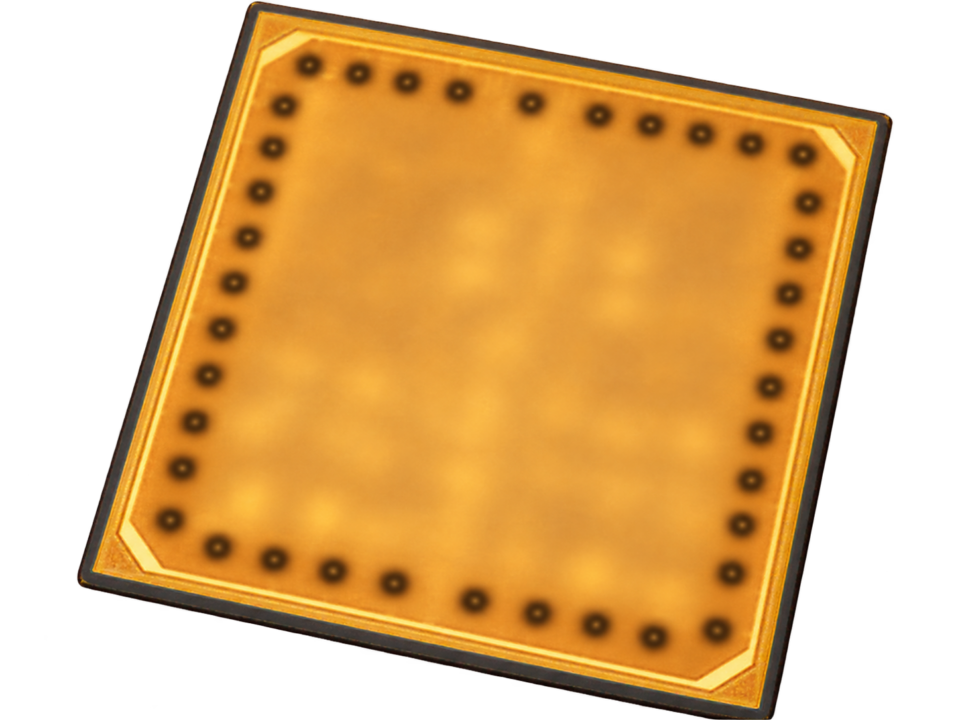
RFFE2840 handles the radio signals between the antennas and the Digital BeamForming Accelerator (DBFA). Its compact design enables distributed antenna placement, with each transceiver connected to the DBFA through a zero-IF I/Q interface.

Key Features

Supported Frequencies and NR Bands
Supports 24.25–29.5 GHz (5G NR bands n258, n257 and n261) and 37–40 GHz (n260).
Dual Transceiver
Two transceiver chains support dual-polarized antennas. Adding RFFE2840 chips and antenna elements increases total transmit power, allowing the same RF chip to serve different application power requirements.
Compact Design
Ultra-small die size of 1.25 mm x 1.25 mm, ideal for space-constrained applications.
Project Sampling
Available for sampling in development projects, supporting advanced prototyping needs.
DBFA – Digital BeamForming Accelerator
The Digital BeamForming Accelerator (DBFA) connects the RF transceivers to the customer’s baseband, digitizing zero-IF signals and handling digital beamforming processing. Each DBFA supports up to eight RFFE2840 chips, providing 16 antenna channels. Control remains with the baseband. Customers can evaluate DBFA functionality today on the FPGA-based ADP1 platform using 5G waveforms. The RFFE2840 RF transceiver is available for project sampling.

Key Features
Scalable Antenna Systems
Multiple DBFAs can be connected in a cascade to support larger antenna systems for CPEs and base stations. Beamforming spans the full antenna array, and the system can connect to the baseband through a single DBFA.
Simplified Baseband Integration
Local processing reduces the baseband workload. Adding antenna channels does not require a higher I/Q data rate at the baseband interface when bandwidth and the number of virtual antenna streams remain unchanged.
ADP1 – Advanced Development Platform
ADP1 combines RFFE transceivers, antennas, FPGA-based DBFA functionality and control software in a complete development and evaluation system.
Key Features
Comprehensive Testing
Includes both ends of the wireless link for over-the-air RF and system testing with 5G waveforms.
Integration Support
Supports customer baseband integration, with test scenarios defined together to match the project’s technical objectives.
Faster Development
Allows customer system development and validation to proceed alongside BeammWave’s chip development.

More Products

Antennas
Compact tri-band patch antennas designed for reliable and efficient 5G performance, ready for sampling in your development projects.

Building Concepts for Distributed Antenna Architecture
Innovative designs for seamless integration of communication solutions, combining performance and flexibility. Available for project sampling.

Explore What Digital Beamforming Can Do for Your Product
Discuss your application with our team and how BeammWave’s chips and development platform can support your evaluation and integration.


